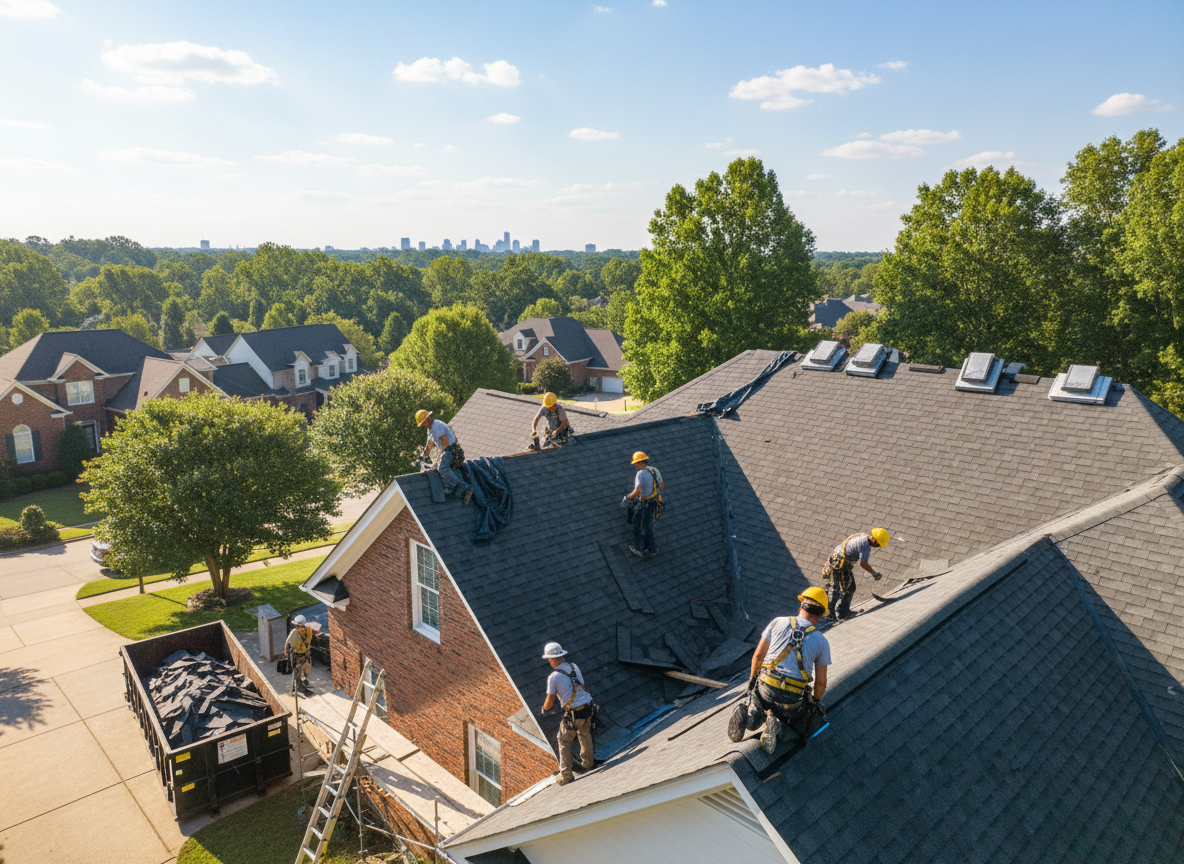
A full roof replacement is the most significant roofing investment a Charlotte homeowner makes, and it is the right call when repairs no longer hold. Full roof replacement charlotte NC work means a complete tear-off down to the deck, inspection and repair of the sheathing, new underlayment, new flashing, and a new shingle system installed to Mecklenburg County code. At roof replacement charlotte, we help homeowners across Mecklenburg County replace aging, storm-damaged, or failing roofs with systems built for the Piedmont climate. If you are researching a full roof replacement Charlotte NC homeowners trust, this page explains what the scope includes, why code and permits matter, and how to time the project around local storm seasons.
Opening block
Charlotte homeowners facing a full roof replacement charlotte NC project are usually at a decision point: leaks have returned after repeated repairs, shingles are missing or curling across the roof, or a hail and wind storm has left the roof compromised. The primary term here describes a full replacement; not a patch, not an overlay, but a complete removal of the old roofing system down to the deck and installation of a new one. Mecklenburg County's climate accelerates this decision: severe thunderstorms and hail strike regularly, NOAA records document hundreds of wind events in the county, and most local asphalt shingle roofs were installed 15 to 25 years ago and last roughly 18 to 22 years in the Piedmont heat and humidity. When the roof has reached that age or taken repeated storm hits, replacement restores the water barrier, protects the structure, and avoids the escalating cost of emergency tarping and interior water damage.
Why us
Pages ranking for full roof replacement charlotte NC tend to describe shingle types and warranties in national terms, rarely addressing the conditions that determine whether a replacement performs here: hail, thunderstorm wind, the local wind code, and Mecklenburg County's permit process. Charlotte sits in a wind zone where North Carolina residential code provisions govern design wind speeds, fastener schedules, underlayment, and anchorage from roof to foundation; requirements that shape every replacement and that generic pages overlook. Most homes in the area carry architectural asphalt shingles, and the local housing stock's age means many roofs are due for replacement at the same time, which drives storm-season demand and pricing. We address full roof replacement charlotte NC work with local specificity: the county permit process through Mecklenburg County Code Enforcement, the code requirements for this wind zone, the storm history that supports impact-rated material choices, and an honest repair-versus-replace assessment based on roof age and condition rather than a sales script.
Why now
The cost of delaying a full roof replacement charlotte NC project compounds faster than most homeowners expect. A roof past its service life loses granules, cracks, and lifts at the seams with each storm cycle, and water that enters travels along rafters and insulation long before a ceiling stain appears. Mecklenburg County's thunderstorm and hail season means a compromised roof faces the next significant weather event within weeks, and each rain event widens the damage; deck rot, mold, damaged insulation, and electrical exposure. Most asphalt roofs in the Charlotte area last 18 to 22 years, shorter than the 25 to 30 years often quoted, because local heat, humidity, and storm exposure age shingles faster. If your roof is approaching two decades old or has survived multiple hail and wind events, scheduling replacement now avoids emergency tarping, premium storm-season pricing, and the interior repairs that follow an unaddressed leak.
Proof
Verifiable local facts anchor a full roof replacement charlotte NC conversation. Mecklenburg County Code Enforcement requires building permits for most full roof replacements and any work involving structural repairs or decking replacement; permits typically run about $100 to $300 with a turnaround of roughly one to three days. North Carolina residential code provisions place Charlotte in a wind zone where design wind speeds govern fastener patterns, underlayment type, and anchorage; a code-compliant replacement is required, not optional, for the system to perform in local storms. NOAA storm-event records document frequent hail and thunderstorm wind activity in Mecklenburg County, which is why impact-rated shingles and proper flashing details matter here more than in calmer climates. These facts come from the county permit page, the state building code, and the NOAA storm events database; public and checkable by any homeowner.
Unique scenario
A situation most full roof replacement charlotte NC pages never address is the replacement triggered by an insurance claim after a hail or wind storm, where the adjuster's initial scope often misses code-required upgrades and secondary damage. In Charlotte, a storm can bruise shingles, lift seals, and damage flashing in ways not visible from the ground, yet still qualify for replacement under a policy. The unique scenario is managing that gap: a contractor who documents storm damage with photos and measurements, references the local wind and hail history that supports the claim, and builds a replacement scope that meets current Mecklenburg County code; including fastener patterns, underlayment, and any decking the county requires during tear-off; rather than simply matching the old roof. National pages discuss insurance generically; they do not explain how a Charlotte replacement interacts with a claim, what code upgrades the county may require, or how to coordinate the inspection timeline so the project is not delayed. That claims-aware, code-based replacement scope is where a local contractor earns the job.
Complete tear-off and deck inspection
A complete tear-off is the removal of every existing roofing layer down to the deck, and it is the defining difference between a full replacement and an overlay. On a Charlotte roof replacement, the tear-off exposes the plywood or OSB decking so rot, water stains, and soft spots can be found and replaced before the new system goes on. What goes wrong: roofers who overlay new shingles over old layers hide deck decay, add weight the structure was not designed to carry, and void the performance of the new shingles. What the homeowner should do or ask: insist on a complete tear-off, require a deck inspection after removal, and get written confirmation that any rotted sheathing will be replaced at a stated per-sheet price before work begins.
Underlayment and ice-and-water shield
Underlayment is the water-resistant layer installed between the deck and the shingles, and ice-and-water shield is the self-adhering membrane used at eaves, valleys, and penetrations where water concentrates. In the Piedmont climate, wind-driven rain from thunderstorms can push moisture under shingles, and the underlayment is the backstop that keeps the deck dry. What goes wrong: skipping underlayment at vulnerable areas, using felt that tears during installation, or leaving valleys unlined. What the homeowner should do or ask: confirm synthetic underlayment is used across the deck, that ice-and-water shield runs at least the code-required distance up from eaves and through valleys, and that the material is rated for the local wind zone.
Impact-rated asphalt shingles
Impact-rated asphalt shingles are designed to resist hail and debris impact, and they are a practical choice for Charlotte given the county's documented hail and thunderstorm activity. Architectural (dimensional) shingles are the most common type on local homes and offer better wind ratings and a longer service life than traditional 3-tab shingles. What goes wrong: installing standard shingles without an impact rating in a hail-prone county, or using a nail pattern that does not meet the local wind-zone code. What the homeowner should do or ask: request architectural, impact-rated shingles, confirm the fastener pattern meets Mecklenburg County's wind-zone requirements (often six nails per shingle in high-wind zones), and verify the manufacturer's wind and impact warranty terms.
Flashing, valleys, and penetrations
Flashing, valleys, and penetration details are where most roof leaks begin, and on a full replacement every piece of flashing should be new or properly re-sealed. Chimneys, skylights, plumbing vents, and roof-to-wall transitions all require step flashing, counterflashing, and sealed valleys to shed water. What goes wrong: reusing old, corroded flashing, improper lap sequencing, or sealant that dries out in the local heat cycle. What the homeowner should do or ask: confirm all penetrations receive new flashing, valleys are lined and sealed, and the flashing warranty matches the shingle system rather than expiring after one year.
Mecklenburg County permit and code compliance
Mecklenburg County Code Enforcement governs roofing permits for Charlotte and the county's towns. A building permit is required for most full replacements, structural repairs, and decking work; fees typically run about $100 to $300 with issuance in roughly one to three days. North Carolina residential code provisions set the design wind speed for this zone and dictate fastener patterns, underlayment, and anchorage, all of which apply to a full replacement. What the homeowner should do or ask: request the permit number before work starts, confirm the contractor schedules the county inspection, and verify the finished roof passes final approval.
Technician insight
A full replacement is also a chance to upgrade beyond the original roof—architectural shingles with six-nail fastening, synthetic underlayment, and sealed valleys align the roof with current Mecklenburg County code rather than older standards, and the exposed deck lets rotted sheathing be found and replaced first.